

Planning IAQ monitors for hotel and guest rooms
Hotel rooms are a hard place to monitor air. Occupancy changes daily, windows are often sealed, and guests will not read a manual. Plan the device around the room, not the other way round.
Start With What the Room Is Likely to Fail On
A guest room has two recurring problems. The first is CO2, which climbs with occupancy and closed windows. The second is particulate matter, which moves when a door opens, a candle is lit or a purifier starts. A monitor that reports both gives the front desk something to act on.
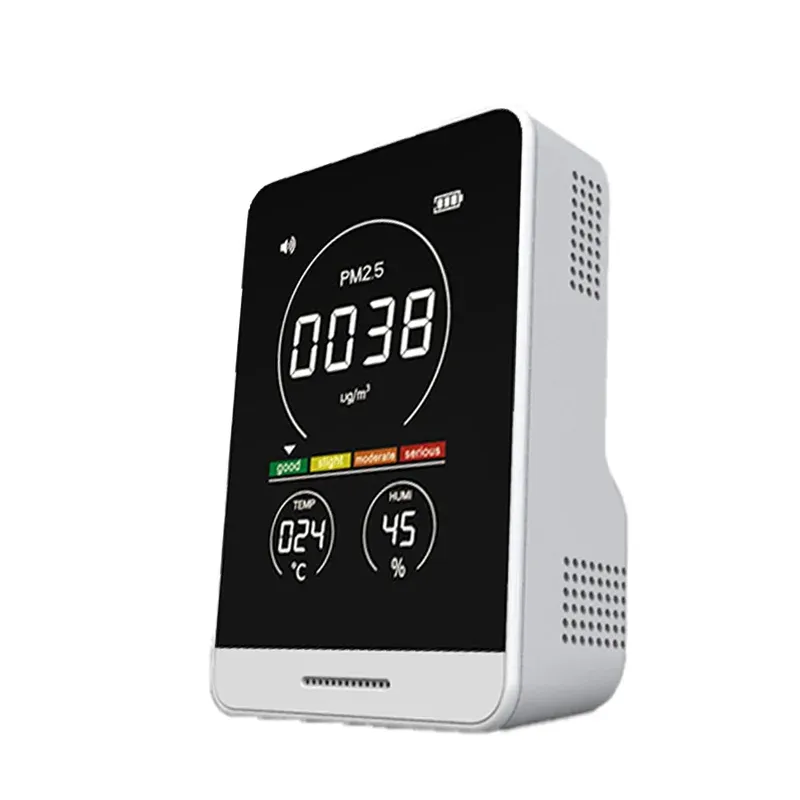
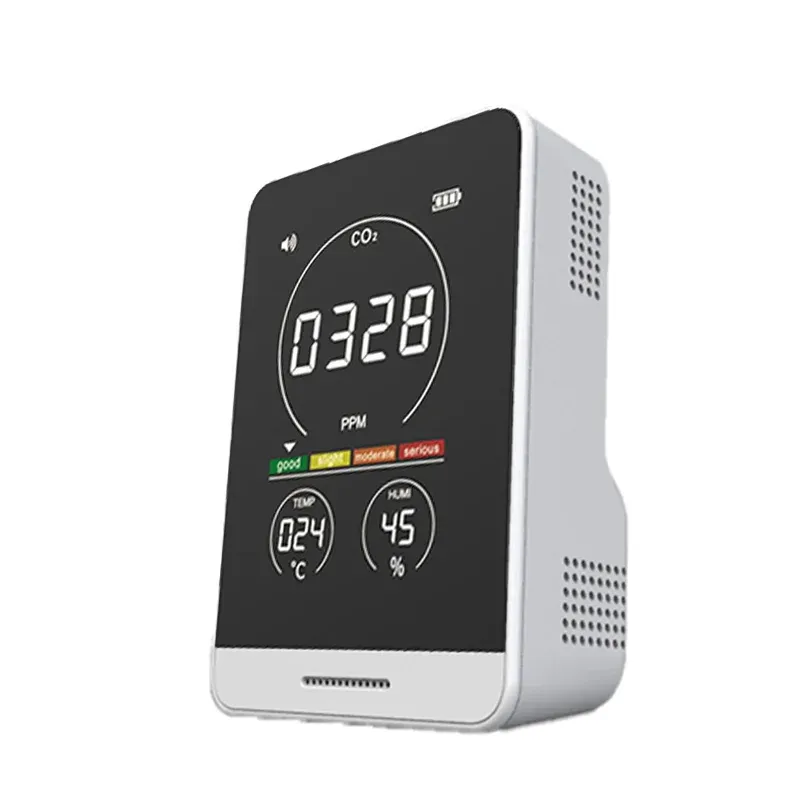
The AK11H reports CO2 by infrared NDIR, so a figure taken next winter can be set against one taken today. The AK11P reports PM2.5 by laser particle counting, and its reading follows events in real time. Both share the same 98 × 32 × 67 mm shell.
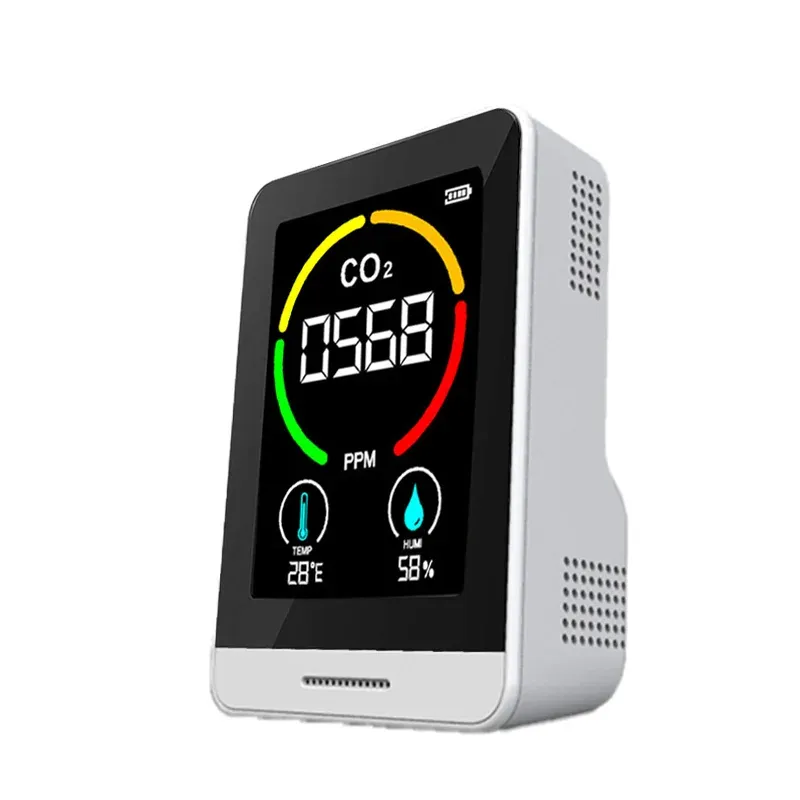
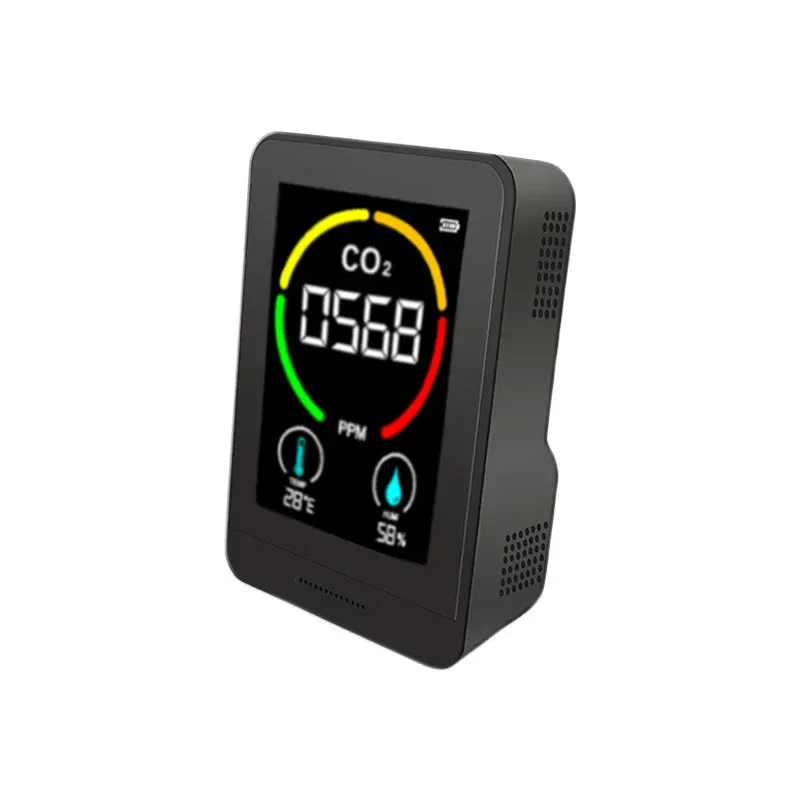
For a single-parameter room, the AK8 puts one CO2 value inside a green-to-amber-to-red arc that registers from across the room. Temperature and humidity sit underneath, because a CO2 figure alone does not explain why a room feels stuffy.
- Choose CO2-only where ventilation is the only question.
- Add PM2.5 where the building sits near traffic or has a kitchen extract nearby.
- Keep temperature and humidity on every unit; they explain movement in the other readings.
Match the Display to Who Reads It
A guest will not learn what TVOC means. The AK16C collapses eight readings into a single 0–500 AQI figure with a colour scale, while all eight underlying values stay on screen. A facilities manager and a guest can read the same device.
Where the monitor sits in a lobby or at reception, presentation matters more than density. The AK22B puts PM2.5 in a large central ring with a full-width AQI scale beneath, a face designed to be read at distance. The AK23A splits particulates and gases into two dials, with a six-step colour and expression scale across the bottom so a guest interprets the air without interpreting the numbers. Its front panel carries no buttons, so the unit reads as furniture rather than instrumentation.
For a back-of-house desk that gets knocked, the AK28A uses a moulded rear wedge instead of a fold-out leg, with four front buttons for clock, alert, brightness and power.
Fit the Form Factor to the Room
Nightstands are small. The AK25A measures 66.3 × 30.6 × 96 mm at 98 g and carries CO2, TVOC, formaldehyde, temperature and humidity, each with its own colour status band. Where the CO2 channel needs to hold steady against humidity swings and cleaning products, the AK25AH puts infrared NDIR into the same 98 g body and packaging.
Where the monitor shares a room with someone asleep, the AK30 dims its own backlight as the room darkens, using a 5000 mAh battery for eight hours of standby. That is the configuration for a bedroom or nursery where the unit stays plugged in rather than being picked up.
The AK35 keeps a 30 mm profile with a 5.5-inch display and three brightness settings. The AK33 is built for walking a building: it stores its own record without a paired handset, at 173 g and 25 mm thick.
Plan for Rooms With Combustion Appliances
Any room with a gas hob, wood stove, unvented heater or attached garage needs carbon monoxide instrumented rather than noticed, because CO is colourless and odourless. The AK16D-CO adds an electrochemical CO cell to the AK16 platform, bringing the count to nine measured parameters with an AQI index alongside. It is positioned as a monitor with an on-screen alert; where local regulations require a listed CO alarm, it sits alongside one rather than replacing it.
For a landlord fitting out many units, the AK32A runs on mains from a 110–240 V socket with US and EU pin variants, so there is no charging cycle to manage.
Confirm the Detail on Each Spec Sheet
The AK11 family runs a 1200 mAh cell for 6–8 hours with roughly three hours to full over USB-C. The AK16 family runs 2000 mAh for six hours. The AK22 and AK23 families run 2500 mAh for six hours. The AK34 runs 5000 mAh for up to eight hours and adds 24-hour and 15-day trend history. Read each sheet rather than assuming the family figure applies across the range.
- Check the sensor class on the sheet before quoting a CO2 or PM2.5 figure.
- Check carton quantity per model; it differs across the range.
- If your programme needs records, the AK33 stores its own history on board and hands the record over later.