

Choosing IAQ monitors for gyms: CO2, particles and sweat
Gyms put unusual demands on an air quality monitor: high occupancy, hard surfaces, heavy breathing and a wide floor area. This guide covers how monitors are deployed in that setting and what to plan for.
What a Gym Floor Actually Needs Measured
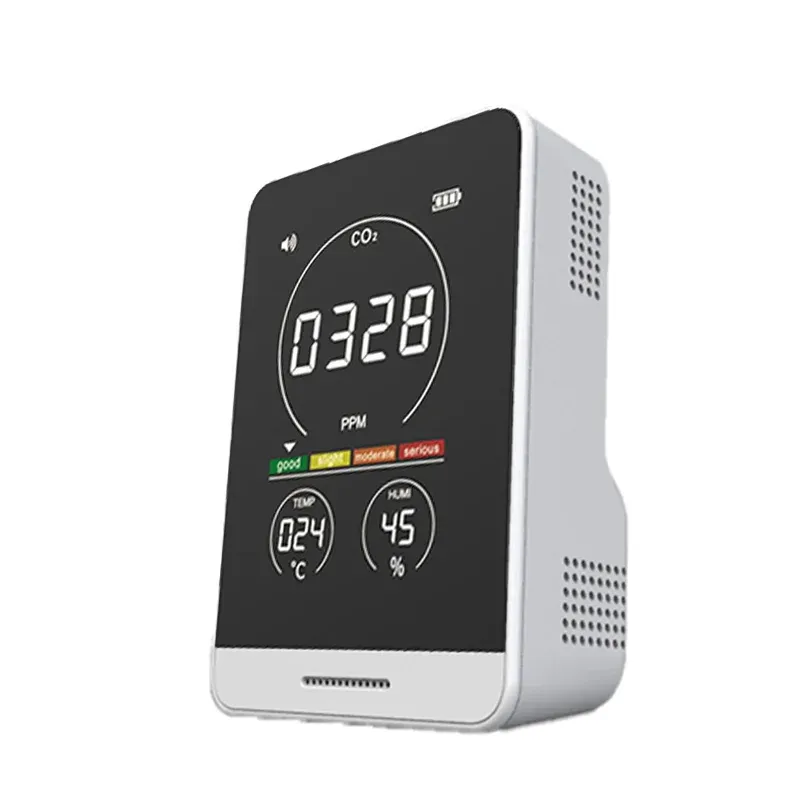
CO2 is the first channel to specify. A busy studio or free-weight floor concentrates people in a small volume, and the CO2 figure shows how well ventilation is keeping up with them.
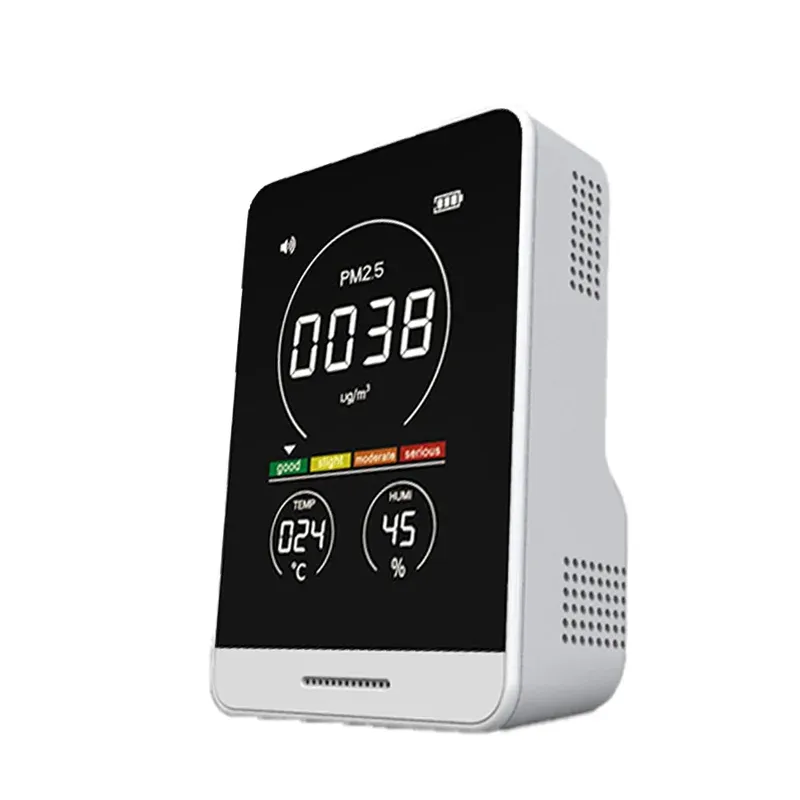
The second channel is particulates. Chalk, dust from mats and equipment, and outdoor air drawn in through street-facing vents all move the PM2.5 reading. A laser scattering module with a fan-drawn sample path produces a µg/m³ figure worth acting on rather than an inferred estimate.
A third channel is worth considering where the building has a gas boiler, a commercial kitchen or an attached plant room. An electrochemical CO cell adds carbon monoxide to the measurement set, and CO is colourless and odourless, which is the reason it has to be instrumented rather than noticed.
- CO2 for occupancy and ventilation performance.
- PM2.5 for dust, chalk and incoming outdoor air.
- CO where combustion appliances share the building.
Choosing Between Single-Parameter and Multi-Parameter Units
Single-parameter units suit a floor where one question dominates. An NDIR CO2 monitor responds to CO2 and nothing else, so cooking vapour, hand sanitiser and air freshener leave the reading untouched, which is what makes a ventilation decision defensible.
Where the buyer wants one device per zone covering the full picture, a multi-parameter desktop unit reports CO2, TVOC, formaldehyde, three particulate fractions, temperature and humidity together, with particulates split three ways by a laser module.
Consider the entry tier carefully. A semiconductor CO2 element tracks the rise and fall that tells you to open a window, which suits occupancy signalling; NDIR accuracy is available in the same enclosure when a customer asks how accurate the number is.
Placement and Coverage Across the Floor
Gyms are rarely one open box. A typical site has a studio, a weights area, a cardio row and a reception, and each behaves differently. A handheld unit with on-board data logging lets a surveyor walk several rooms in sequence and read back where the levels changed, which a spot-reading monitor cannot support.
For permanently sited monitoring, the display layout matters as much as the sensor set. A large-screen grid gives CO2, particulates, formaldehyde, TVOC and the climate readings equal weight, which suits a technician scanning for the one value that has moved.
Where the device faces members rather than staff, a single index number is easier to act on. An AQI bar collapses eight readings into one figure with a colour scale, while all eight underlying values remain on screen, so a facilities manager and a member can read the same device.
- Handheld logging units for survey work and commissioning.
- Grid displays for staff-facing positions.
- Index displays for member-facing positions.
Power, Mounting and Durability
Gyms are hard on equipment. A moulded rear wedge sets the screen at a reading angle without a fold-out leg to snap off, which is the version to specify for a desk or counter that gets knocked.
Runtime shapes the deployment. A 5000 mAh unit with eight hours of standby is built to run continuously rather than be picked up and put down, and an ambient light sensor drops the backlight as the room darkens.
For humid areas such as a poolside corridor, a shower block or a covered outdoor training area, a sealed enclosure is the only sensible choice, and it runs on two AAA cells so nothing has to be opened to keep it running.
What to Confirm Before You Specify
Confirm the sensor class for each channel you intend to quote. Infrared measurement does not age the way a semiconductor element does, so a figure taken next winter can be set against one taken today.
Confirm the enclosure and carton specification across the models you plan to stock. Several ranges share tooling and packaging, so a mixed pallet ships as a single line item and two display tiers can come from one production line.
Certifications vary by model and are shown on each product spec sheet. Check the spec sheet of every model you intend to order rather than assuming a common set across the range.
- Sensor class per channel.
- Shared enclosure and carton spec across the range.
- Certifications on the spec sheet of each model.