

Choosing CO2 monitors for open-plan offices and meeting rooms
Open-plan offices and meeting rooms share one problem: occupancy changes faster than the building does. The monitors you specify here have to make ventilation visible to the people in the room.
What This Setting Actually Needs
A meeting room can go from two people to twelve in ten minutes. An open floor plate has the opposite pattern — steady occupancy, uneven air movement, and pockets where CO2 collects while the rest of the floor reads fine. The instrument has to show a trend occupants can act on, not a laboratory figure nobody in the room can interpret.
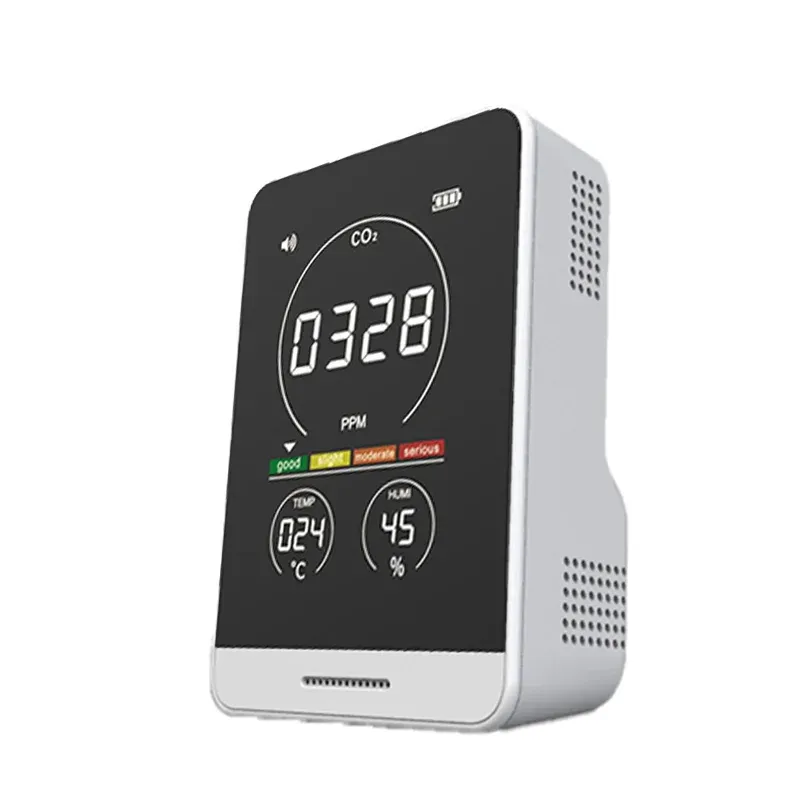
The AK11T is the entry point for this: a semiconductor element tracks the rise and fall that tells you to open a window, and the colour bar under the digits moves green to red as the level climbs, so occupants act on the band without learning what 1000 ppm means. For rooms where the number itself has to be quoted in a report, the AK11H moves the CO2 channel to infrared NDIR, which does not age the way a semiconductor element does, so a figure taken next winter can be set against one taken today.
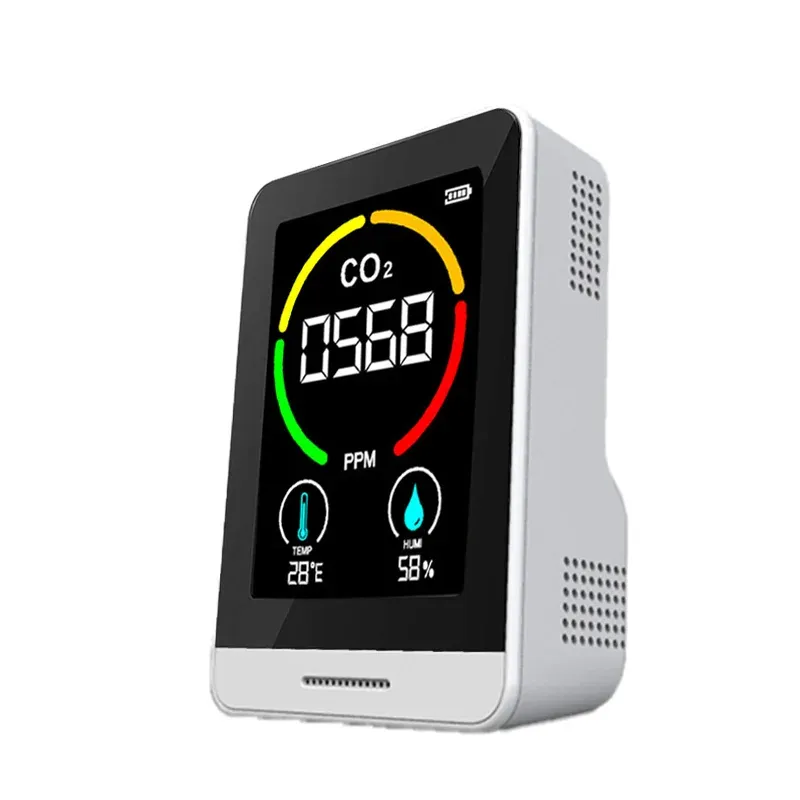
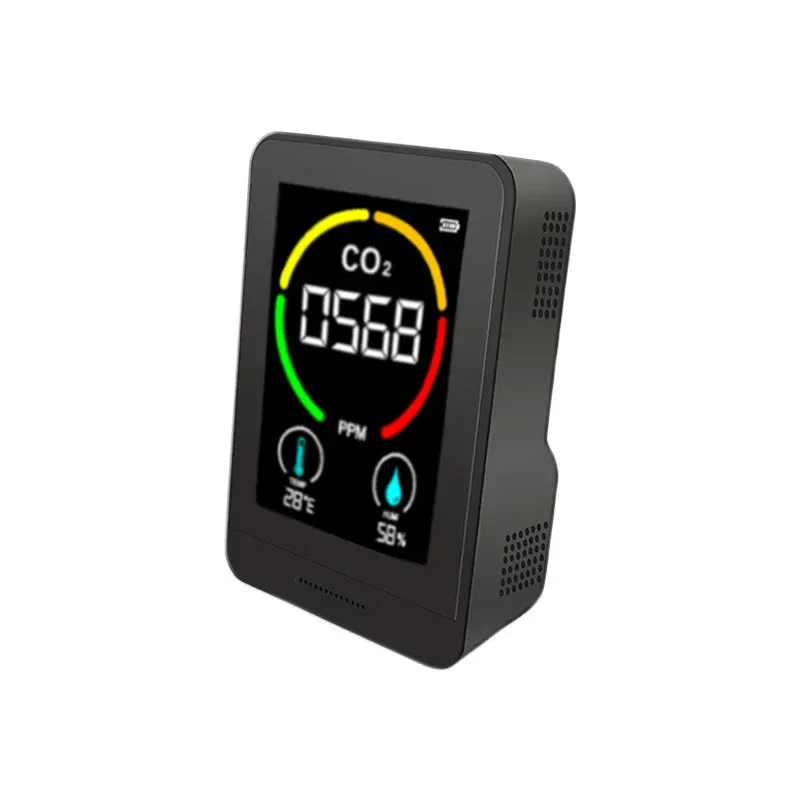
If CO2 is the only parameter you are buying, the AK8 puts a single value inside a green-to-amber-to-red arc that fills the screen, with temperature and humidity in two supporting circles underneath. NDIR responds to CO2 and nothing else, so cooking vapour, hand sanitiser and air freshener leave the reading untouched.
Single-Parameter or Full Panel
Decide early whether each room gets one reading or eight. A CO2-only unit is the cleanest proposition where the question is purely ventilation. A full panel suits rooms where you also want to know what else is in the air.
The AK16A reports CO2, TVOC, formaldehyde, PM1.0, PM2.5, PM10, temperature and humidity on a 24 mm panel, with each reading carrying its own colour band so nothing needs checking against a reference table. Particulates are split three ways by a laser module, because a single lumped particulate number hides which fraction is elevated. The AK16C adds an AQI bar that collapses the eight readings into a single figure with a colour scale, while all eight underlying values remain on screen — the index is a layer on top, not a replacement.
For larger rooms, the AK22A gives six values tiled on a wide colour LCD, sized to be read standing up from the other side of a room. The AK22B uses the same eight-parameter sensing and the same enclosure, but places PM2.5 in a large central ring with a full-width AQI scale beneath — a face for a lobby or reception desk where people glance rather than study.
- AK11T and AK11H: CO2, temperature, humidity; 98 × 32 × 67 mm; 1200 mAh
- AK8: CO2, temperature, humidity; arc display; 1200 mAh
- AK16A and AK16C: eight parameters; 120 mm × 93 mm × 24 mm; 2000 mAh
- AK22A and AK22B: eight parameters; 166 mm × 108 mm × 53 mm; 2500 mAh
Placement and the Walk-Around Check
Fixed monitors tell you about the room they sit in. Meeting rooms and open floors often need a second method: a handheld unit that surveys several spaces in sequence and produces a record.
The AK33 stores its own history on board, so it logs whether anyone is there or not and hands the record over later. It measures all eight parameters and weighs 173 g, which suits walking a building and reading back where levels changed. The AK34 records both 24-hour and 15-day trend history, which makes pollution patterns and daily changes easier to compare.
Where a monitor has to run continuously rather than be picked up and put down, the AK30 carries 5000 mAh and eight hours of standby, and an ambient light sensor drops the backlight as the room darkens. The AK35 has a 3500 mAh battery for up to 15 hours of cordless use and a 5.5-inch display.
Power, Mounting and the Room's Own Constraints
Open-plan floors rarely have a socket where the monitor needs to sit.
The AK18B is wall mountable at 39 g, with CO2 and TVOC on separate colour status bands and about six hours of standby from a 500 mAh cell. The AK25A fits where a desktop unit will not — nightstands, shelves, a car cup holder — at 98 g with five readings. The AK25AH puts infrared NDIR CO2 into that same mini body, so humidity swings and cleaning products leave the reading where it is.
For desks that get knocked, the AK28A uses a moulded rear wedge to set the screen at a reading angle without a fold-out leg, and gives clock, alert, brightness and power their own front keys. The AK23A separates particulates and gases into two dials with clock and climate down the centre, and its front panel carries no buttons.
- Check the socket position before you specify a cordless model's runtime
- Match enclosure to surface: wedge stand, wall mount or mini body
- Confirm the CO2 sensor class per model before quoting a figure
Specifying for a Multi-Room Rollout
Once the sensor class is settled, the practical work is packaging and consistency. Several models share an enclosure across tiers, which simplifies a mixed order.
The AK3 and the NDIR version AK4 share the same body, colour box and 50-per-carton pack, so a distributor carries both tiers on one pallet with a single freight calculation. The AK11 family follows the same pattern: AK11T, AK11H, AK11P and AK11C share tooling, colour box and carton spec. The AK23A and AK23B share enclosure, packaging and carton spec, so two distinct products come from one tooling.
Before you commit, check the spec sheet of each model for its own certifications — they are listed per model there, not in this article. Confirm the sensor class, the readings, the power method and the carton specification model by model, because the differences between tiers in the same family are often confined to one channel.