

Choosing a wall-mount or desktop IAQ monitor for your programme
An IAQ monitor programme succeeds or fails on matching the sensing to the room. This guide compares wall-mount and desktop options by use case, so you can specify one platform across many sites.
Start With the Reading the Room Must Produce
The first decision is not the enclosure but the parameter. A CO2 reading tells you how many people the ventilation is failing to keep up with, while a TVOC reading shows what the room's materials and cleaning products are adding.
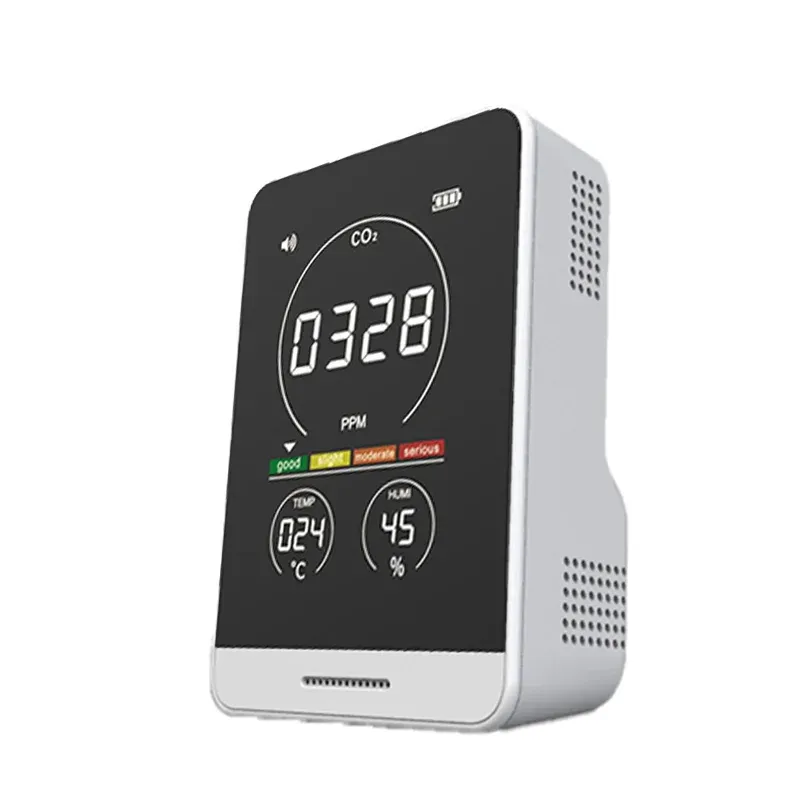
For occupancy alone, the AK11T tracks the rise and fall that tells you to open a window, and its colour bar moves green to red as the level climbs so occupants act on the band without learning what 1000 ppm means. Where the figure has to be quoted rather than trended, the AK11H replaces the semiconductor CO2 element with infrared NDIR, and infrared measurement does not age the way a semiconductor element does, so a figure taken next winter can be set against one taken today.
Particulates are a separate question. The AK11P uses a laser scattering module with a fan-drawn sample path, producing a µg/m³ figure worth acting on rather than an inferred estimate, and it responds in seconds when a door opens, a candle is lit or a purifier starts.
- CO2 trend only: AK11T, AK8
- The AK11H provides an infrared CO2 figure suitable for reporting, and the AK4 also carries an NDIR infrared CO2 sensor for a quotable number
- Formaldehyde focus: AK11C
- Particulates only: AK11P
Wall-Mount, Desktop or Handheld
Form factor decides where a device can live and who will read it. The AK22A gives 166 × 108 mm of body, nearly all of it display, with every reading sized to be read standing up from the other side of a room without leaning in. Its sibling AK22B puts PM2.5 in a large central ring with the remaining readings arranged around it and a full-width AQI colour scale beneath, a face intended for a lobby, reception desk or shop floor where people glance rather than study.
Where a device must survive handling, the AK28A uses a moulded rear wedge that sets the screen back at a reading angle without a fold-out leg to snap off, and four buttons give clock, alert, brightness and power their own key on the front. For survey work, the AK33 stores its own record, so it logs whether anyone is in the room or not, and at 173 g and 25 mm thick it reads like an instrument in the hand rather than an ornament on a desk.
The AK18B is wall mountable at 39 g, and each reading carries its own colour band so the screen answers the question without being read closely.
Matching the Parameter Count to the Site
A single-purpose device is easier to explain; a multi-parameter device is easier to install once. The AK16A reports CO2, TVOC, formaldehyde, three particulate fractions, temperature and humidity on a 24 mm panel, with the particulates split three ways by a laser module because a single lumped particulate number hides which fraction is actually elevated. The AK16C adds an AQI bar that collapses eight readings into a single 0–500 figure with a colour scale, while all eight underlying values remain on screen, so a facilities manager and a guest can read the same device.
The AK34 records both 24-hour and 15-day trend history, which makes pollution patterns and daily changes visible rather than recalled. The AK30 adds an ambient light sensor that drops the backlight as the room darkens, in a 5000 mAh body designed to run continuously rather than be picked up and put down.
- The AK8 is the cleanest single-parameter CO2 proposition in the range, while the AK11P is a single-purpose PM2.5 meter and the AK18A is a single-parameter CO detector
- The AK3, AK4, AK25A and AK25AH each present five readings with their own colour status bands
- The AK16A, AK16C, AK22A, AK23A, AK33 and AK34 all measure eight parameters, with the AK33 weighing 173 g and the AK34 adding 24-hour and 15-day trend history
Where the Monitor Sits and Who Reads It
Placement changes the specification. The AK23A separates particulates on the left dial and gases on the right, with clock and climate down the centre, and its controls sit out of sight so the front panel reads as furniture rather than instrumentation in a hotel room or showroom. The AK23B instead makes PM2.5 dominate the centre of the screen at several times the size of anything else, readable from a distance no dial layout matches.
For the smallest installations, the AK25A packs CO2, TVOC and formaldehyde with temperature and humidity into a 98 g body that fits hotel nightstands, a shelf in a nursery or a car cup holder. The AK25AH carries the same five readings with the CO2 channel moved to infrared NDIR, stable where humidity swings, hand sanitiser and cleaning products leave a semiconductor reading wandering.
Where a room needs carbon monoxide coverage, the AK16D-CO adds an electrochemical CO cell, which suits kitchens with gas hobs, homes with a wood stove or unvented heater, attached garages and boiler rooms; it is positioned as a continuous sited monitor with an on-screen alert, and where local regulations require a listed CO alarm it sits alongside one rather than replacing it.
Certifications and Programme Fit
Certifications differ by model and by market, and each model's certifications are shown only on its product spec sheet. Check the spec sheet of each model you shortlist before committing a programme to it, and confirm the declared list against your destination market.
Platform sharing is the practical lever for a multi-site rollout. The AK3 and the NDIR version AK4 share the same body, colour box and 50-per-carton pack, so a distributor carries both tiers on one pallet with a single freight calculation. The AK16A and AK16C likewise share an enclosure, packaging and 30-per-carton spec, giving two tiers from one production line. The AK23A and AK23B share an enclosure and 32-per-carton spec, so two distinct products reach your catalogue at the cost of one tooling.
- Confirm the carton quantity and outer dimensions per model before planning a pallet
- Confirm the readings list per model, since similarly named models differ by sensor class